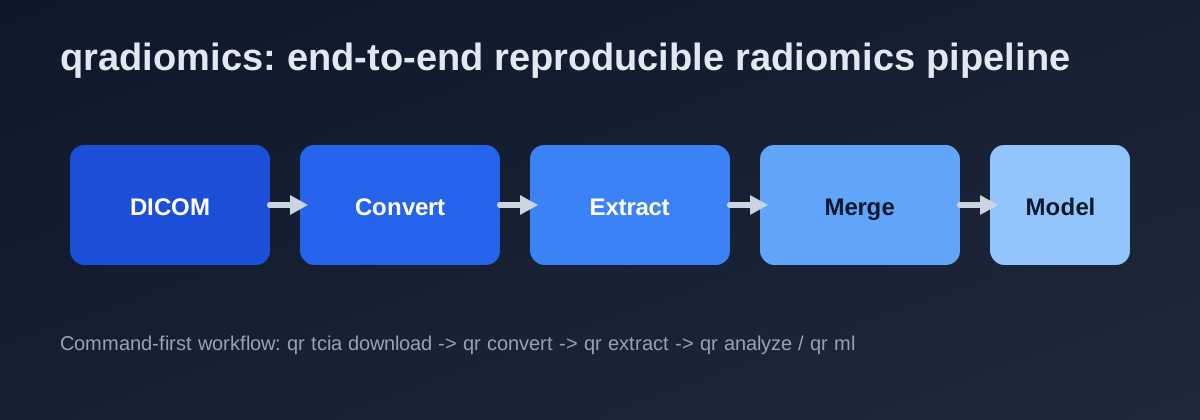
qradiomics workflow overview

Introducing qradiomics — A Unified Radiomics CLI for Reproducible Research

We are releasing qradiomics — an open-source Python CLI that unifies more than a decade of Choi Lab radiomics work into a single, reproducible, pip-installable toolkit. What is qradiomics? qradiomics (command: qr) is a radiomics research CLI built for the full data flow from raw DICOM to published-grade results: DICOM download → conversion → feature extraction → clinical merge → modeling Each step is a single Unix-style command. Pipelines are assembled from those atomic commands using plain JSON plans, executed by Nextflow (per-patient parallel), Prefect, or inline. One command gets you started: ...

May 20, 2026 · 5 min · 900 words · Wookjin Choi

qradiomics — Radiomics Research CLI

License: MIT · Python: 3.11+ · Version: 0.9.0 · Repo: choilab-jefferson/qradiomics Active successor for three earlier Choi Lab radiomics codebases. The C++/MATLAB pipelines in taznux/radiomics-tools, taznux/lung-image-analysis, and choilab-jefferson/LungCancerScreeningRadiomics are superseded by this repo. The feature extractors are now in qradiomics.feature.rtools (Python ITK port, numerically exact to the C++ binary). New work should land here. Radiomics research CLI. qr does two things equally well: Atomic tasks — convert DICOM, extract features, merge clinical, fit a model. Each is a single command, files in / files out. Workflow assembly — generate, mutate, scaffold, and run multi-step pipelines from those atomic tasks. Default executor is Nextflow (per-patient parallel + cache + HPC); Prefect is the secondary executor; inline is the small-cohort fallback. The canonical radiomics data flow has four stages — data → image → features → modeling — and one qr workflow plan call instantiates the whole chain: ...

May 17, 2026 · 14 min · 2874 words · Wookjin Choi

Clinically-Interpretable Radiomics

MICCAI'22 Paper | CMPB'21 Paper | CIRDataset This library serves as a one-stop solution for analyzing datasets using clinically-interpretable radiomics (CIR) in cancer imaging (https://github.com/choilab-jefferson/CIR). The primary motivation for this comes from our collaborators in radiology and radiation oncology inquiring about the importance of clinically-reported features in state-of-the-art deep learning malignancy/recurrence/treatment response prediction algorithms. Previous methods have performed such prediction tasks but without robust attribution to any clinically reported/actionable features (see extensive literature on the sensitivity of attribution methods to hyperparameters). This motivated us to curate datasets by annotating clinically-reported features at the voxel/vertex level on public datasets (using our published advanced mathematical algorithms) and relating these to prediction tasks (bypassing the “flaky” attribution schemes). With the release of these comprehensively-annotated datasets, we hope that previous malignancy prediction methods can also validate their explanations and provide clinically-actionable insights. We also provide strong end-to-end baselines for extracting these hard-to-compute clinically-reported features and using these in different prediction tasks. ...

June 29, 2022 · 5 min · 1002 words · Wookjin Choi

Reproducible and Interpretable Spiculation Quantification for Lung Cancer Screening

Choi, W., Nadeem, S., Alam, S. R., Deasy, J. O., Tannenbaum, A., & Lu, W. (2020). Reproducible and Interpretable Spiculation Quantification for Lung Cancer Screening. Computer Methods and Programs in Biomedicine, 105839. https://doi.org/10.1016/j.cmpb.2020.105839 Source codes: https://github.com/choilab-jefferson/LungCancerScreeningRadiomics Highlights A novel interpretable spiculation feature is presented, computed using the area distortion metric from spherical conformal (angle-preserving) parameterization. A simple one-step feature and prediction model is introduced which only uses our interpretable features (size, spiculation, lobulation, vessel/wall attachment) and has the added advantage of using weak-labeled training data. ...

November 17, 2020 · 3 min · 451 words · Wookjin Choi

Quantitative Cancer Image Analysis

November 3, 2019 · 0 min · 0 words · Wookjin Choi

Radiomics in Lung Cancer

October 1, 2018 · 0 min · 0 words · Wookjin Choi

Interpretable Spiculation Quantification for Lung Cancer Screening

UKC2018 Aug 4, 2018 MSKCC Postdoctoral Research Symposium Sep 28, 2018 https://twitter.com/arxiv_org/status/1034746650089021445 Presented at MICCAI ShapeMI Workshop https://shapemi.github.io/program/

September 11, 2018 · 1 min · 18 words · Wookjin Choi